About
NESRİN KARSAVURAN
Passionate home cook, lifelong student of Anatolian tradition.
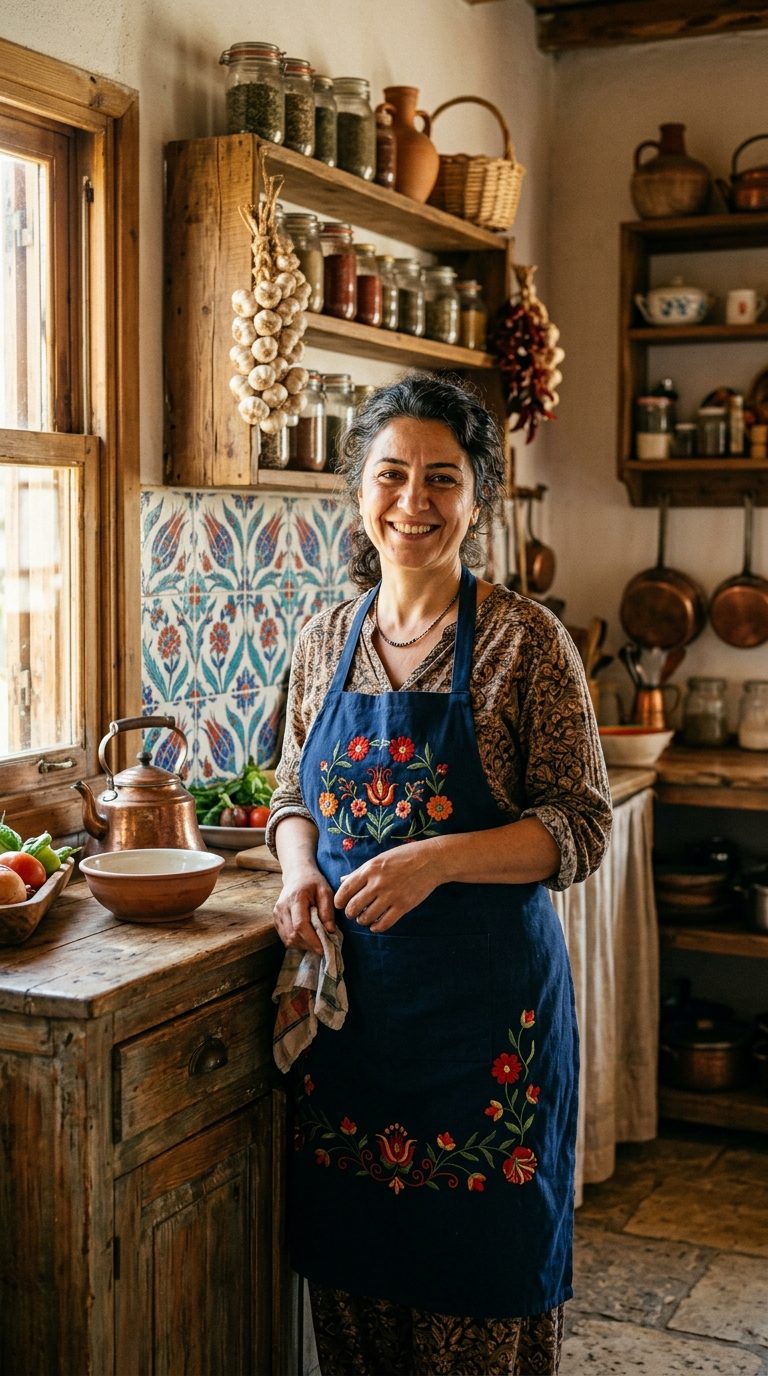
"Every recipe I write is a love letter to the women who cooked before me — my grandmother Hatice, my mother Fatma, and all the aunts whose hands knew exactly how much salt a pot of soup needed without ever measuring."
— Nesrin Karşavuran
From Grandmother's Kitchen in Manisa, to Your Table
I grew up in Manisa, a city draped in history at the foot of Mount Sipylus, where the air in summer smells of figs and dried thyme. My earliest memories are not of toys or playgrounds — they are of standing on a small wooden stool beside my grandmother Hatice, watching her coax fire from a wood-burning hearth and turn a handful of simple ingredients into something that made the whole neighbourhood pause at our gate.
Grandmother Hatice was not a cook by profession. She was something far more powerful: a woman who fed her family with intention, with seasons, with memory. She knew which butcher kept the best kuzu eti, which market stall had the sweetest Manisa fig, and she knew — instinctively — that a proper tarhana çorbası needed at least three days of patient fermentation before it earned the right to sit at a winter table.
Those mornings in her kitchen were an education no school could give me. I learned that Ege cuisine — the food of the Aegean interior — is quieter than Istanbul's grandeur and more delicate than the fiery dishes of the southeast. It depends on exceptional produce: wild purslane, fresh dill, hand-pressed olive oil from the groves of Akhisar, and lamb that has grazed the meadows of the Gediz valley. The seasonings are restrained because the ingredients speak loudly enough on their own.
"She taught me that patience is the most important spice in any Turkish kitchen. You cannot rush a proper etli güveç any more than you can rush the olive trees to fruit."
Years later, when I moved to İzmir for university and then spent time working in Istanbul's restaurant world, I realised something troubling: the dishes I had grown up with were disappearing. Not dramatically, not overnight — but slowly, the way old photographs fade. Young cooks did not know how to prepare keşkek for a village wedding. Supermarket shelves replaced the corner bazaar. Grandmothers were passing away, and their recipes existed nowhere except in muscle memory that was going with them.
That realisation became the seed of nesrinkarsavuran. I began by writing down every recipe I could remember from Hatice's kitchen. Then I started visiting older women across Manisa and the broader Aegean region — sitting at their tables, recording their methods in exhaustive detail, asking the questions their own grandchildren had never thought to ask. How many times do you knead the dough? What time of year do you pick the grape leaves? How does the filling change when you cannot find fresh herbs?
What began as a personal archive became a blog, and the blog became a community of people who share my belief: that Turkish culinary heritage is not a museum exhibit — it is a living, breathing practice that deserves to be cooked, eaten, argued about, and passed on. Every recipe I publish here has been tested in a real home kitchen, written for real people who do not have professional equipment or unlimited time, and traced back to its regional roots as carefully as I can manage.
My particular focus remains the Aegean interior — Manisa, Akhisar, Salihli, Alaşehir, the villages of the Gediz plain — because this is the cooking I know most deeply and the cooking I believe is most at risk of being forgotten. But I also travel, research, and collaborate with home cooks from Gaziantep, Kastamonu, Trabzon, and everywhere in between. Turkish cuisine is vast, plural, and deeply regional; no single voice can document it all, but every honest voice is worth something.
My Mission
- Document authentic regional recipes before they disappear from living memory.
- Write recipes that home cooks can actually follow, without professional equipment.
- Tell the stories behind every dish — the geography, the seasons, the families.
- Build a permanent, searchable archive of Turkish culinary heritage, freely accessible to all.
If you have found your way here, I suspect you already understand what I am trying to do. You remember the taste of something your own grandmother made. You want to recreate it honestly, not as a shortcut or a simplified version, but as the real thing — as close to the source as a modern kitchen allows. That is exactly what I am here to help you do. Welcome.
A Kitchen Built on Values
Behind every recipe on nesrinkarsavuran are three principles passed down through generations and refined over a lifetime of cooking.
Fresh, Local & Seasonal
Every dish begins at the market. Nesrin believes that the soul of Turkish cooking lives in its ingredients — sun-ripened tomatoes from the Aegean, mountain herbs plucked at their peak, pomegranates pressed in autumn. When you cook with what the season offers, the flavour speaks for itself. No shortcuts, no substitutes.
Honouring Ancient Techniques
Turkish cuisine stretches back thousands of years, woven through the kitchens of nomads, palace cooks and village grandmothers. Nesrin meticulously preserves regional variations — the slow-braised stews of Black Sea winters, the wood-fire breads of Central Anatolia, the delicate pastries of the Ottoman palace kitchen — so they are never lost to time.
Turkish Food for Every Kitchen
You don't need a wood-fired oven or a Turkish grandmother's hands to make authentic food. Nesrin carefully adapts every recipe for home cooks anywhere in the world — explaining unfamiliar ingredients, suggesting accessible substitutes, and breaking down complex steps so that the joy of a proper Turkish meal is never more than an evening away.
"Cooking is not just about feeding the body — it is about feeding memory, family, and the land you come from."— Nesrin Karsavuran